poetry
Karma, Man
Let us know if a poem moves you!
Karma, Man

The captains of industry did not temper their lust and greed, so they will destroy themselves as everything collapses underneath.
The already poor and suffering will be able to shrug their shoulders because they’ve always been poor and suffering.
For them, death is a heavenly exit.
The middle classes will be bitching Karens as their suffering starts—
like now, with forest fires, collapsing glaciers, earthquakes, and explosive heatwaves making their lives miserable.
Once the walls in their homes are moldy,
the floors are covered in mud,
and the electricity goes out so they can’t get AC—
and not even a room at a hotel is an option because crypto won’t pay the bill when the power is out—
they will start to see what their privilege and lack of compassion led to.
Karma, man.
But their lesson won’t take hold.
And so they will attack the affluent 1% they once wanted to be part of—
their allegiance having been with the billionaire class rather than the blue collars they despised—
as those guys flee to their underground bunkers and private islands,
their flock of cameras and monitors showing them the crowd quickly approaching—
with pitchforks and AK-47s.
© 2026 Elizabeth McDargh. All rights reserved. 09/01/26
New Orbit
Let us know if a poem moves you!
Karma, Man

The sun is cooking us.
Well, not really.
It’s the fossil fuel farts.
Hiding in the shadows above our heads.
Trapped under the skin of our small blue marble.
We breathe that air,
barely noticing the ironic results
of our willful ignorance.
They laugh when the sun hits deadly hydrocarbons.
They chuckle when
Mother Earth’s crust gets cooked.
And flooded.
And barren.
She will begrudgingly have the last laugh.
Like menopause—
the heat rises.
Glaciers melt.
Their weighted-blanket protection
thinning into torrential rivers.
This gives magma a chance to yawn.
Expanding beneath our one, single, solitary,
habitable blue marble—
like my feet on a 102-degree day.
She swells too,
liquid rock restless beneath her crust.
Today—
red, fiery eruptions
like explosive diarrhea
through the caldera floors
of Mount Etna,
Stromboli,
Great Sitkin,
and Kīlauea.
And also, forty others
around the world today.
When no crevices are found,
the magma pushes on.
Pushes and pushes.
Like a bulldozer
clearing the way.
Then the Earth quakes.
Indonesia.
Venezuela.
Colombia.
Mexico.
Japan.
Spain.
But maybe aliens
give us the temperature we want.
Or take us back
to a time when
we could still reverse course.
Maybe back when Carter warned us—
when the truth was inconvenient.
Or maybe they can just
push the Earth
into a new orbit—
680,000 miles farther away.
At 680,000 miles farther out,
maybe the Sun’s rays
won’t sting the skin as badly.
Maybe.
But the fossil farts
will still be there.
It’s delusional, right?
Do we need a miracle—
or a reality check?
Maybe the deniers will repent.
Fossil-fart makers might confess
they designed the deny-and-deflect plan.
Selling doubt.
Pimping oil.
It’s too late
for the trees already burned.
But the trees burned
because of their greed.
The stench of human suffering
will spare no one.
Those responsible
will not be able to flee
the air
they cooked up
for us to breathe.
© 2026 Elizabeth McDargh (08-15-2026)
Let us know if a poem moves you!
Let us know if a poem moves you!
Let us know if a poem moves you!

The Next Epidemic
I Want to Have a Voice
Let us know if a poem moves you!

I can’t wait for the epidemic of kindness—
a pandemic of goodwill.
That moment when real Southern hospitality arrives
in the Northern hemisphere,
hugging us with Midwest kindness.
If we must wear a mask, I hope it is filled
with Wisconsin’s neighbor-to-neighbor energy,
and Minnesota Nice is in the fabric.
I want our bones to feel the no-nonsense
kindness of Iowa, Nebraska, and the Dakotas.
May it become our daily constitutional walk.
I hope our symptoms include Louisiana’s charm and kindness.
I want window and balcony cheering—grace—in surround sound.
Oh, I can’t wait for the day
aloha is the ocean we swim in,
and everything around us
resonates with the simple truth:
each one of us is a blessing to the other.
Elizabeth McDargh, 2026
I Want to Have a Voice
I Want to Have a Voice
I Want to Have a Voice

I want to have a voice—
A voice that calms,
that soothes,
that cools tempers,
inspires the muse,
shines rays over the downcast.
I want to have a voice—
A voice that inspires
and opens the heart,
that melts prejudice
to only act to protect and respect,
that nurtures confidence lost.
I want to have a voice—
A voice that makes my heart remember
its first contraction
and the loving womb where I came from;
that guides my steps
even when the fog blocks
the flicker of light
illuminating the path ahead.
I want a voice—
That resonates
at a high energy level
with the angels;
that shines on tarnished memories,
dissolves angry thoughts,
washes away the hurt
and tormented visions,
shrinks shame
and regret.
I want a voice
so empowered
and capable
that it can—
and willingly does—
transmute the sounds
of willful ignorance
into waves
of heartfelt action.
That’s the voice I want.
Elizabeth McDargh, 2026
El Mundo es Simple
I Want to Have a Voice
I Want to Have a Voice

El mundo es complejo
Cuando uno se pone a contemplar.
La complejidad del ser humano
Se encuentra en su abilidad de cuestionar.
Pero esta libertad no bien utilizada
Puede destruir nuestra sensibilidad.
La sensibilidad que poseemos dentro del alma,
Dentro de nuestra gran humanidad.
No debemos tomar por ley toda dicha palabra
Sino preguntar sobre su validad.
Debemos encontrar su proposito final
En este blanco y negro mundo de la oscura realidad.
Tenemos la abilidad de pensar y de razonar…
Podemos preguntar, enfocar, y progresar.
Por que entonces debemos pelear?
Pelearnos con otros,
Ajenos y cercanos,
Pelearnos, con hermanos…
Es cuestion, me supongo, de preguntar y escuchar,
De querer ayuda,r, y de querer vivir en paz.
Cuando nos pongamos de Nuevo a contemplar
Podremos ver que el mundo es simple en realidad!
Elizabeth McDargh, 1986
Translation
The World Is Simple
The world is complex when one contemplates it.
The complexity of the human being is found in their ability to question.
But this freedom not well utilized can destroy our sensibility.
The sensibility that we posses within our soul
…..within our great humanity.
We should not take as law all spoken word.
… but to ask its final purpose.
In this white and black world of dark reality
we have the ability to ask, focus and improve.
Why then do we have to fight?
To fight with others…
….remote and near.
To fight, with brothers…
It is a mater, I suppose, of asking and listening,
To want to help, and to want to live peacefully.
When we once again contemplate our role
…we will see that the world is really simple.
Elizabeth McDargh, 1986
Hourglass of Life
Hourglass of Life
Hourglass of Life

I look at you and know friendship
I see through you and find honesty
I look beyond you and see your true nature.
I walk beside you and feel respect.
Within the hourglass of life,
We meet some very special people,
Those that leave an everlasting impression,
And those that become lifelong friends.
The sand falls telling time,
All following the same direction.
They feel prisoner of their own race,
Wanting to enjoy, like others, the sea.
Sea and Sun, two lifelong friends,
Know each other as well as one another.
Together merge as Sun descends
See their respect, ambition, honesty, friendship,
The Hourglass is now one.
Elizabeth McDargh
December 82
Simple Thanks
Hourglass of Life
Hourglass of Life

Not too long ago,
I met this very old man.
He was in a wheel-chair
And looked quite unhappy.
I smiled…
Suddenly his eyes sparkled.
He smiled back.
I walked up to him
And he thanked me.
For what I asked?
For giving him something he needed… Love.
Later that evening I went to my friends house.
As she opened the door she smiled.
I smiled too.
We talked and laughed…
And when I was leaving I thanked her.
For what she asked?
For being very special to me… My Friend.
When I went home and started to write this poem,
I smiled and thanked God.
For what you ask?
For giving us the gift of friendship and Love,
And a smile to show we care no matter what.
Elizabeth McDargh
1987
One
Hourglass of Life
Pensar

If one should ponder a minute
one could find that
one still has time to do
one extra great task in this life.
If one could qualify this journey through life
one would find that
one has yet time to make better
one more thing in this life.
If one would examine this behavior
one will find that
one still has time to make smile
one more man, woman, or child.
If one should think some time
one could find that
one would not be, but
one will become at last more than one.
Elizabeth McDargh
April 1987
Pensar
The Storm and You
Pensar

Me supongo la paradoja del hombre
Se encuentra en la ironia de su vida.
Yo pienso, a veces sola,
Que el hombre vive…
…pero no da vida.
A veces nos creemos tan superiors,
Que nos olvidamos de nosotros mismos.
Es el agonista contra el protagonista.
Los que pelean por creer, y los que
Creen por pelear.
Y asi me supongo
Seguiremos nuestra vidas enteras.
Luchando con othros mediate palabra…
O Madera.
Porque cada hombre que empieze a pensar
Encontrara, como yo,
Que es ridiculo el luchar.
Me supongo que despues de siglos
De luchar, no vamos a cambiar.
Pero si yo con estas simple palabras
Puedo hacerte a ti pensar,
Ya he consequido mas
Que ellos con su pelear.
Elizabeth McDargh, 1986
Translation
Think
I suppose the paradox of man
Is found in the irony of his life.
I think, sometimes alone,
That man lives...
...but does not give life.
Sometimes we believe ourselves so superior
That we forget ourselves.
It is the antagonist against the protagonist.
Those who fight to believe, and those who
Believe to fight.
And so I suppose
We will continue our whole lives.
Fighting with others through words...
Or might.
Because every man who begins to think
Will find, like me,
The ridiculously of fighting.
I suppose that after centuries
Of struggle, we will not change.
But if I, with these simple words,
Can make you think,
I have already achieved more
Than they have with their fighting.
Elizabeth McDargh, 1986
The Storm and You
The Storm and You
The Storm and You

Listen to the wind
And from its tales learn.
Look above the sky, and
Without opening your eyes
Can you tell who you are? Were?
See what lies ahead of you,
What crosses your path.
What have you learned?
Reaching your goals was your ambition
But such are dreams we have.
Will you try over and over, again?
Be proud of what and who you are,
Strive to reach the calmness,
That which comes before the storm.
Only you can change what is wrong, so
Accept your mistakes, make them your last.
It will be tough; a test for your soul
‘cause fighting the storm is not an easy task.
Elizabeth McDargh
December 82.
Photo Gallery - Childhood Memories FROM FOLLOWING MY FATHER ON HIS MILITARY DEPLOYMENTS

Bindlach American Elementary, Germany, Photo sometime 1968-1972

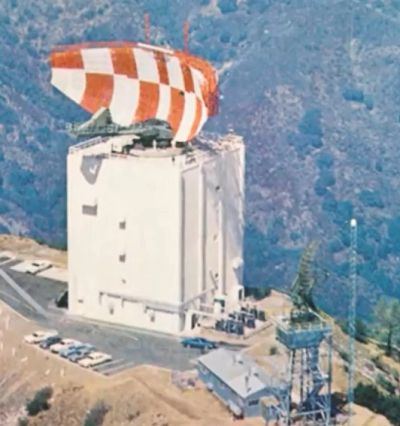
Almaden Air Force Station & Radar Site (San Jose, California (USA) - From the late 1950's until the mid 1980's, the USAF operated Almaden Radar Site on the summit of Mt. Umunhum, located near San Jose, California. My father was stationed here for a short time around 1966-68.
Air Force History – The eight--story concrete tower pictured to the right is behind where the picture above was taken. The base holding the radar dish was operated by the US Air Force. It is located in near San Jose, CA. Between 1957 and 1980, the Air Force used Mount Umunhum’s (name means resting place of the hummingbird) spectacular views to help protect the West Coast from the possible threat of Soviet planes during the Cold War. The Almaden Air Force Station permanently closed in 1980 when satellite technology made the radar station here obsolete. Some military veterans who worked at the Air Force Station took their technical skills down the mountain and contributed them to the growth of Silicon Valley. (more info https://www.youtube.com/watch?v=APCx1zOdTH0) More info on Facebook #USAF682ndRadarSquadron